

Why fertility preservation is a hot topic in 2025
More couples are choosing to delay parenthood for career, education, or life-planning reasons — and fertility preservation is becoming a mainstream option rather than a last resort. Freezing eggs (oocyte cryopreservation) and freezing sperm are both being discussed more frequently as viable ways to preserve reproductive options for the future. For example, one resource shows that egg-freezing cycles registered a nearly 40% year-over-year increase from 2022 to 2023.
In parallel, the recognition that male fertility contributes to roughly half of all infertility cases is growing — meaning sperm freezing and male fertility preservation are becoming more visible and accessible.
For anyone trying to conceive (or planning to), it’s valuable to know what these options mean, when they make sense, what the pros & cons are — and how they might integrate with your family-planning timeline. Our goal is to help you understand both sides (female and male) and how to evaluate whether fertility preservation is a strategy worth discussing with your specialist.
Egg freezing: what it involves and why women choose it
What is egg freezing?

Egg freezing (technically “oocyte cryopreservation”) is a process where a woman’s eggs are extracted, frozen, and stored so that they can potentially be used later for fertilization. The process typically involves hormone stimulation, monitoring of follicle development, egg retrieval under sedation, and then vitrification (rapid freezing) for long-term storage (Healthline).
While egg freezing has existed for decades, the technology has become more efficient. Vitrification methods used today drastically reduce ice-crystal formation, improving egg survival rates after thawing. According to the American Society for Reproductive Medicine (ASRM), this advancement has made elective egg freezing a mainstream part of fertility care.
Why women are choosing it
Some of the common reasons include delaying motherhood for career/education, waiting for the right partner, or preserving fertility because of medical conditions (e.g., treatment that might affect ovarian reserve). For example, healthy women are now opting for elective egg freezing more than ever, with clinics reporting record numbers of cycles completed in 2024.
Beyond lifestyle reasons, women undergoing cancer treatments or facing autoimmune diseases also turn to egg freezing as a protective step. The National Cancer Institute highlights that fertility preservation is now a critical part of cancer care plans, especially for younger patients.
Who should consider egg freezing — and when
Age is one of the most important factors. As egg quality and quantity decline with age, freezing eggs earlier (often before the mid-30s) yields better outcomes. If you are considering waiting several years before trying for a baby, or you have a medical condition that might affect fertility, then egg freezing may be worth discussing with a specialist.
Data show that women are freezing their eggs at younger ages and seeing improved results. Moreover, the global market for egg-freezing and embryo banking is projected to grow significantly, reflecting wider acceptance and usage of the technique.
The sperm side: why male fertility preservation is gaining traction
Why sperm freezing matters
Many fertility discussions center on women, but male fertility plays an equal role. According to recent research, male-factor infertility contributes to about half of all infertility cases worldwide. That means men (and couples) need to consider preservation options too.
Sperm quality also declines with age. Studies have shown that older men may experience DNA fragmentation, reduced motility, and lower conception rates. Preserving sperm during younger years can help maintain the best possible quality for future family planning.
When sperm freezing is an option
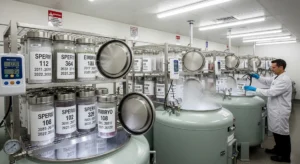
Sperm freezing (cryopreservation) may be considered for men before undergoing medical treatments that could affect fertility (e.g., chemotherapy, surgery), or men planning to delay fatherhood but want to preserve options. The process is simpler than egg freezing, which has made it more accessible.
Advances in sperm-banking technology and fertility-clinic services mean men now have more realistic access to this option. The CDC also notes that awareness about male infertility has improved, encouraging more men to take proactive steps.
Key questions and decision points before you proceed
How many eggs or sperm should you freeze?
For eggs: The number retrieved and frozen matters because retrieval at younger ages and higher numbers increase the chance of future success. For sperm: While numbers vary, quality matters (motility, morphology, DNA integrity, etc.), and freezing earlier can be advantageous. Clinics usually recommend retrieving 15–20 mature eggs for women under 35, while men typically need only one sample of healthy sperm for cryopreservation.
What are the costs, risks, and success rates?
Freezing eggs involves ovarian stimulation, monitoring, retrieval under sedation, and then freezing — typically over 2–3 weeks. Success is not guaranteed — age at freezing, number of eggs retrieved, and individual health all matter. For sperm, while retrieval is simpler, long-term outcomes still depend on how and when the sperm is used. Also consider the cost of storage, future IVF/ICSI use, and the possibility of never using the frozen material.
For example, one study found that although egg-freezing cycles surged, only a small proportion of women returned to use their frozen eggs within 5–7 years. This underscores that freezing does not equal guaranteed pregnancy — it preserves an option, not a promise.
Does freezing guarantee a baby later?
No. It preserves options — it does not guarantee success. One site notes that freezing eggs “doesn’t pause biological aging” and doesn’t guarantee a pregnancy — CBS News. Therefore, the decision should be aligned with realistic expectations and informed by a specialist.
How to integrate preservation into your conception plan
Map your timeline and goals
Begin by asking: When do we want to try for a baby? At what age will you be then? What health or life variables (career, partner, finances) might come into play? If you expect to delay parenthood by several years, preservation may be more relevant.
Meet with a fertility specialist
Whether you’re considering freezing your eggs or sperm, schedule a consultation with a reproductive endocrinologist or fertility expert. They can assess ovarian reserve (for women) or semen parameters (for men), discuss realistic outcomes, and walk you through the process.
Don’t rely solely on preservation — maintain fertility health now

Freezing is not a substitute for healthy, fertility-friendly habits now. A strong foundation — healthy weight, good diet, moderate exercise, reducing smoking/alcohol, managing stress — is still vital. The frozen material may be the backup, but your natural fertility should not be neglected. For related guidance, check our posts on nutrition for fertility and how to track your ovulation & maximize your chances of conception.
Pros & cons: is it right for you?
Benefits
- Preserves reproductive options when parenthood is delayed.
- Offers peace of mind for those with potential fertility-threatening health issues.
- For men and women, it increases flexibility when attempting conception.
Considerations and drawbacks
- Cost: Retrieval, freezing, storage, and future use all add up.
- No guarantee of success — age, number, and quality matter.
- Emotional/psychological implications: decision-making, expectations, future use.
- Women: The process is invasive (hormone stimulation, retrieval). Men: fewer invasions but still decisions, potential anxiety.
Final thoughts
Deciding whether to freeze your eggs or sperm is a deeply personal choice — shaped by your age, health, life plans, and fertility goals. While technology continues to evolve and fertility preservation is more accessible than ever, it is not a “magic insurance policy”. Instead, it should be viewed as one tool in your broader fertility toolkit.
If you are considering this path, build a plan: map your timeline, maintain strong fertility health now, meet with a specialist, and weigh the benefits, costs, and expectations fully. Whatever you choose, staying informed empowers you and your partner to make confident decisions on your fertility journey.
For more on related topics, check out our posts on smart tech for new parents – high-def ultrasounds & keepsake innovations, and 5 common myths about getting pregnant – debunked.